Quick Answer
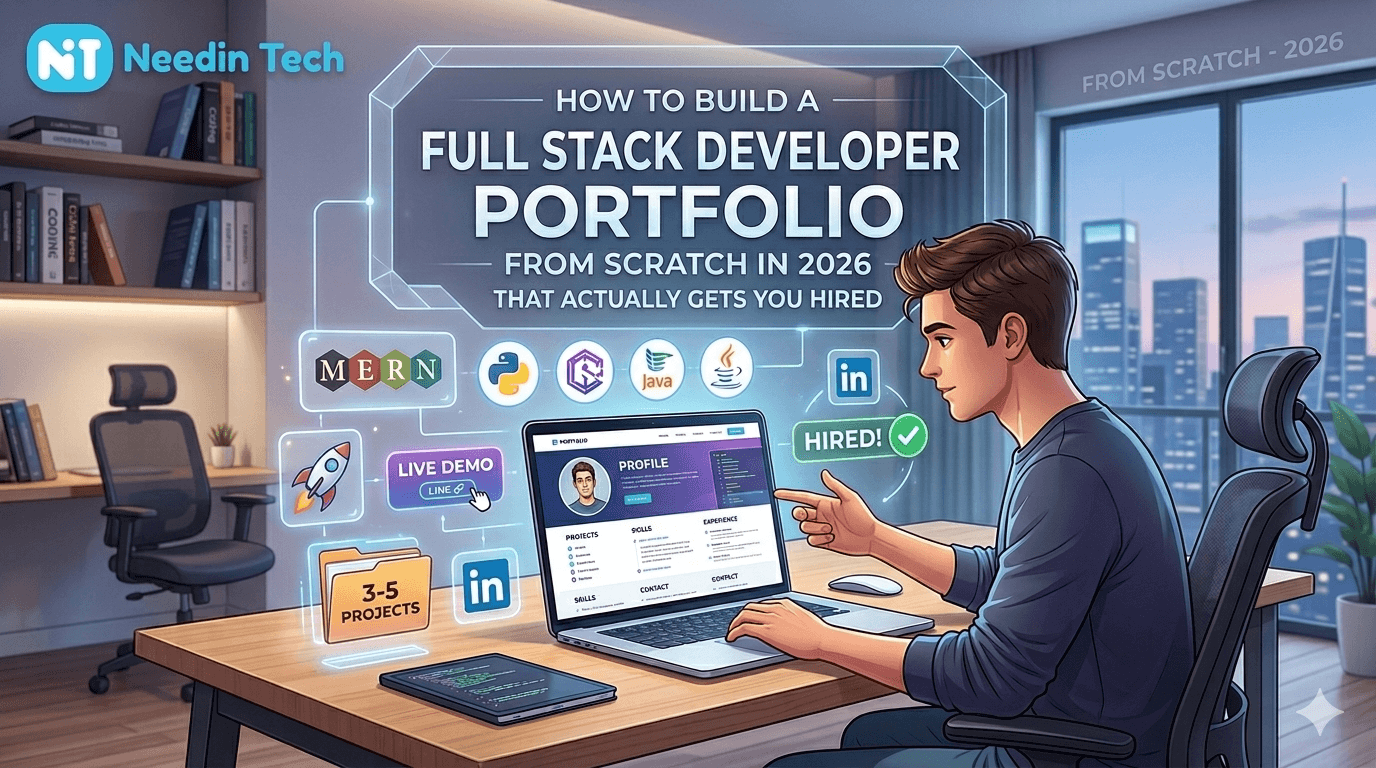
Learning how to build a full stack developer portfolio from scratch is simpler than most freshers think. Pick one tech stack, build 3 to 5 real projects with live demos, push your code to GitHub with clean documentation, and deploy everything online. Hiring managers consistently respond to a well-built portfolio more than a degree or a list of certifications.
What is a full-stack developer portfolio, and why does it matter more than your degree in 2026?
Here is something most freshers do not hear early enough. Hiring managers do not spend time reading through your educational qualifications before deciding whether to call you in. A 2025 survey of over 500 hiring managers found that 84% want to see working applications when they review a developer’s profile, not just a GitHub link they have to clone and run locally. That single fact tells you everything about what your portfolio needs to be.
A full stack developer portfolio is a curated collection of your projects, your code, and your problem-solving ability, all in one place that anyone can access with a single link. Unlike a resume, which tells people what you claim to know, a portfolio shows them what you have actually built. Recruiters can see your frontend work, your backend logic, your database design, and your deployment setup all at once. That kind of evidence moves you from the maybe pile to the shortlist.
In 2026, this kind of evidence matters more than it ever has. Given the tightening job market in the tech industry, having three to five well-crafted, deployed projects that load quickly and present themselves like mini case studies will capture a recruiter’s attention. Surface-level familiarity with ten technologies will not suffice. What hiring managers ultimately want to know when they open your profile is simple: has this person actually built something that works? Your portfolio provides the most convincing answer to that question.
This information is especially relevant for freshers, non-IT graduates, and career switchers. You may not have two years of professional experience, but a strong portfolio levels the playing field faster than anything else. At NeedinTech, every full stack development program is built around this reality, giving learners the hands-on project experience they need to walk into interviews with something real to show.
Thinking about starting your full stack journey? Explore NeedinTech’s full stack development courses and see what is right for you.
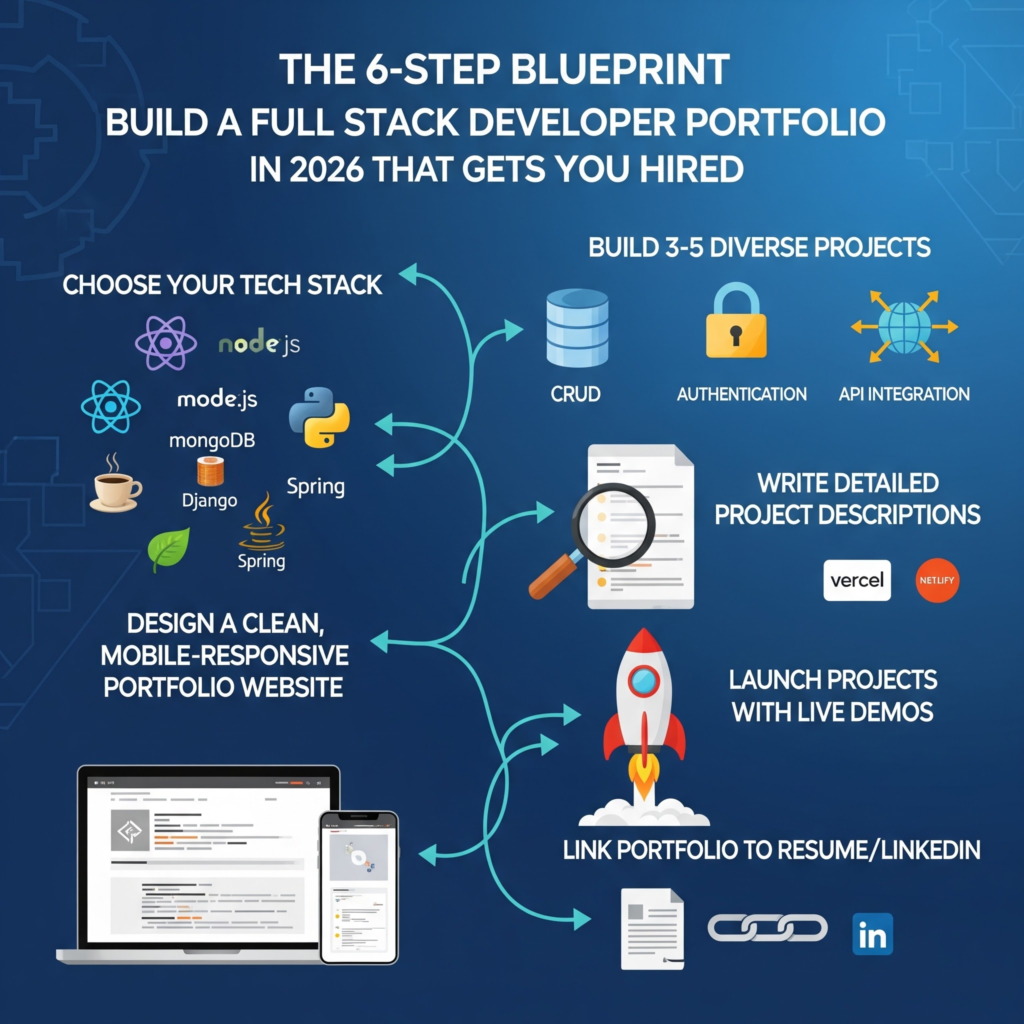
How to Build a Full Stack Developer Portfolio from Scratch: The 2026 Blueprint
There is a sequence that works. It is not complicated, but most people skip steps and then wonder why their portfolio is not getting any traction. If you follow these steps, you will be in a much better position than most new applicants for the same jobs.
Choose Your Tech Stack Before You Build Anything
One of the most common mistakes freshers make is trying to learn everything at once. Pick one stack, learn everything you can about it, and then use it to make your portfolio. That’s what interviewers really care about.
The MERN stack, which includes MongoDB, Express.js, React, and Node.js, is a good place for most new developers to start in 2026. The Stack Overflow Developer Survey 2025 asked more than 49,000 developers from all over the world which web frameworks they use the most. The most popular ones were Node.js and React, with 48.7% and 44.7% of developers using them, respectively. If you like working with apps that use a lot of data or products that use AI, the Python full stack with Django or Flask is a wonderful choice. Java Full Stack with Spring Boot is still the most popular choice in banking, big businesses, and big IT companies. If you are exploring other paths, the MEAN Stack and LAMP Stack are also worth understanding depending on your target industry.
Your desired work and target companies will determine the best stack course for you. There is no single wrong answer here, but there is a wrong approach, and that is spending a little time on each stack without going deep on any of them.
Not sure which stack suits you best? Browse NeedinTech’s full stack course options and find your starting point.
Pick Projects That Go Beyond the To-Do App
Most portfolios fail at this stage. A to-do app tells a recruiter you can follow a tutorial. A deployed e-commerce platform with authentication, payment flow, and search tells them you can build something real.
Your portfolio needs three to five projects, each one demonstrating a different aspect of your stack. Here is a practical mix that works well in 2026:
A CRUD-based app, like a blog platform or task manager, shows that you know the basics, like how to design a database, structure an API, and render a frontend. At least one of these is something that every recruiter wants to see.
An authentication-based platform using JWT or OAuth shows you understand how to keep user accounts secure, which is a skill every production application depends on. A booking system, a user dashboard, or a community forum all work well here. NeedinTech’s backend development training covers authentication patterns in the context of real projects, so you build this skill while working on something portfolio-ready.
You can show that you can work within real-world development limits by doing an API integration project that connects third-party services like a weather app, a payment gateway, or a tool that integrates maps.
Your anchor project is a full-featured app that combines all three, like a chat app that works in real time, an online store, or a tool for managing projects. This is the one you go over in detail in every interview. Make sure to build it right, put it to use, and write down everything about it.
Three polished, fully deployed projects make a stronger impression than eight half-finished ones with broken links. That is something hiring managers say consistently, and it holds true at every experience level.
Looking for guided project-based learning? From day one, NeedinTech’s MERN Stack course revolves around portfolio-ready projects.
Build and Host Your Portfolio Website Step by Step
Your portfolio website is itself a portfolio project. How it looks, how fast it loads, and how easy it is to navigate tells a recruiter something about you before they have read a single line of your project descriptions.
Keep the design clean and simple. Avoid overly complex animations or heavy visual effects that slow the page down. According to iHire’s State of Online Recruiting 2025, over 65% of job applications are now submitted via mobile devices. Your portfolio is no different. If it does not load and navigate cleanly on a phone, a significant number of the people reviewing it will simply move on. It is the baseline. A solid understanding of HTML, CSS, and JavaScript gives you the foundation to build a portfolio site that looks professional without needing a design background. If you are comfortable with React, building your portfolio as a React application is a good way to showcase your frontend skills at the same time.
Structure your portfolio around these core sections: a brief hero section with your name and role, an about section that explains who you are and what you are working toward, a skills section organized by category covering frontend, backend, database, and tools, a projects section with 3 to 5 entries, and a contact section with your LinkedIn and GitHub links.
For hosting, Vercel, Netlify, and GitHub Pages are all free, quick, and reliable. If you want to go one step further, registering a custom domain such as yourname.dev or yourname.tech adds a level of professionalism that is genuinely memorable to hiring managers and effortless to set up.
Want to strengthen your frontend skills before building your portfolio site? Explore NeedinTech’s frontend development course.
Write Project Descriptions That Recruiters Actually Read
This phase is the step that separates a portfolio that gets noticed from one that gets scrolled past. Most freshers describe their projects in one or two vague lines. Every time, the result is a missed opportunity.
For each project, cover four things clearly. Start with the problem: what real-world issue does this application address? Then explain your approach. What technical decisions did you make and why? Follow that with the tools and stack you used, and finish with the outcome. For example, instead of writing “built a task management app,” write “built a task management application with drag-and-drop workflows and real-time updates, designed for teams of up to ten users.” The second version tells a recruiter something specific. The first tells them nothing useful.
Your GitHub README file carries equal weight. A well-written README should include a one-paragraph project description, a screenshot or demo GIF, the tech stack used, setup instructions for running the project locally, and a link to the live demo. Recruiters and technical reviewers both check READMEs, and a clean, detailed one signals that you take your work seriously.
One more thing worth doing: use informative and purposeful commit messages in Git. A commit history that reads “fix,” “update,” or “stuff” tells a reviewer nothing. A history that reads “add JWT authentication middleware,” “optimize MongoDB query for user search,” and “fix mobile layout on checkout page” tells them you think and work like a professional.
Want to build projects that are genuinely interview-ready? NeedinTech’s backend development course covers project structure, documentation, and version control in a real-world context.
Launch Every Project with a Live Demo
This requirement is non-negotiable in 2026. Recruiters strongly expect live demos over code-only repositories. A clickable, interactive link that lets you test right away is much more useful than a GitHub repository that you have to clone and run on your own computer.
At the beginner level, Netlify and Vercel make it easy and free to deploy both the front end and the full stack. For backend services and database-connected applications, platforms like Render, Railway, or Cyclic offers free tiers that are more than enough for portfolio projects. If you want to go further, deploying on AWS or using Docker to containerize your application shows a level of technical maturity that stands out at the fresher level. NeedinTech’s DevOps and tools training covers these skills, and they are becoming more common in job descriptions, even for entry-level positions.
Before you share your portfolio with anyone, make sure that all of the links work. One of the quickest ways to lose a recruiter’s interest is to have broken demos, apps that crash when they load, or projects that need you to sign up before you can see anything.
Ready to learn deployment from scratch? Explore NeedinTech’s DevOps and cloud tools course.
Connect Your Portfolio to Your Resume and LinkedIn
Your portfolio, resume, and LinkedIn profile need to tell the consistent story. Recruiters move between all three during the evaluation process, and inconsistencies between project names, tech stacks listed, or timelines create doubt about your credibility.
On your resume, include your portfolio URL prominently near your name and contact details. For each project you list, use the same description language you used in your portfolio. Keep the framing consistent. On LinkedIn, pin your portfolio URL in your featured section. Use the projects section to mirror your portfolio, and make sure your skills section only lists technologies you’ve actually built with, not ones you’ve just read about.
A well-maintained LinkedIn profile carries real weight in the current developer hiring environment. Hiring teams look for new hires who are proactive and always learning. One way to show this is to get involved with the developer community, share what you’re working on, and connect with professionals at the companies you want to work for. If you want to work as a full stack developer, being an active learner on LinkedIn early in your training can give you an edge over other new hires that many people don’t realize.
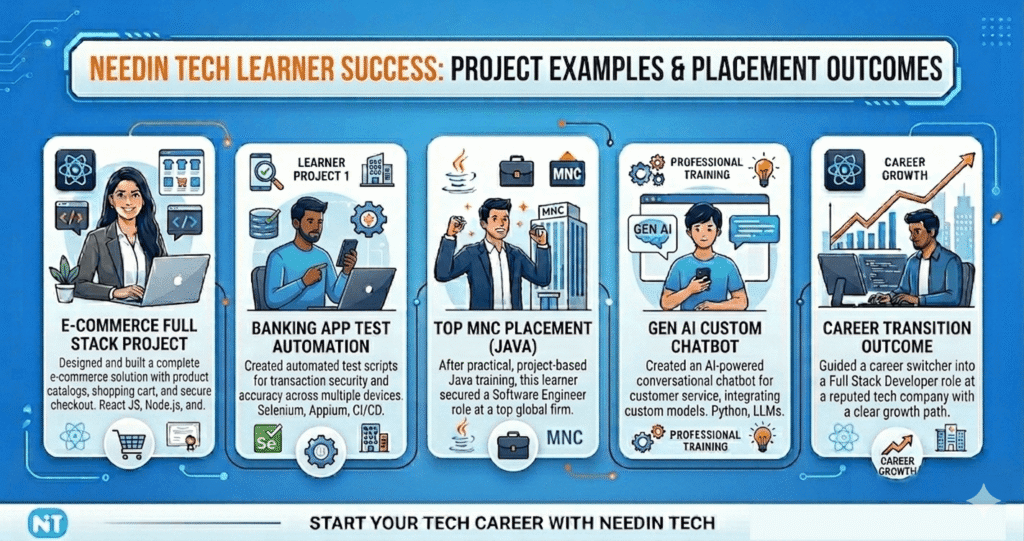
Building your profile alongside your portfolio? NeedinTech’s placement support helps you present your skills the right way to the right employers.
What Recruiters Actually Look For in a Full Stack Portfolio in 2026
The 2025 report from LinkedIn on the Future of Recruiting reveals that 93% of talent acquisition professionals view the accurate assessment of a candidate’s skills as essential for making quality hires. What that means in practice is simple: when a hiring manager opens your portfolio, they want proof that you can build things that actually work. Functional projects, clean code, and a GitHub history that shows you keep improving is what moves you forward. A portfolio that remains untouched since completing your course quietly undermines your chances. Even small changes, like fixing a bug, adding a feature, or updating a dependency, show that you care about your projects as living products.
In 2026, recruiters will also look for proof that you know how a web application works from start to finish. That means designing the frontend UI, backend API, database structure, authentication, and deployment, all of which should be visible in one anchor project. Being able to explain your architectural choices in simple terms, like why you chose MongoDB over MySQL, how you handled authentication, and how you set up your API, sets apart candidates who have actually built things from those who have just followed tutorials.
The developers who frequently secure interviews are not necessarily the most technically skilled. They are the ones whose portfolios give hiring managers a clear and confident picture of what they can build and how they think.
Ready to build the kind of portfolio that gets recruiter attention? Start with NeedinTech’s full stack development courses.
Full Stack Developer Portfolio Checklist 2026
Before sharing your portfolio with any employer, make sure each of these is in place:
- Your portfolio website is live, mobile-responsive, and loads quickly.
- You have between 3 and 5 projects, each with a working live demo link and a GitHub repository link.
- Every project has a clear description covering the problem, your approach, the stack used, and the outcome.
- Each GitHub README has setup instructions, at least one screenshot showing the app in action, and a link to the live demo.
- Your commit history is clean, and your commit messages are descriptive enough for anyone reading them to understand what changed and why.
- Your skills section is organized by category and only lists technologies you can confidently talk through in an interview.
- Your portfolio URL is on both your resume and your LinkedIn profile.
- Every link in your portfolio has been tested and confirmed working before you share it with anyone.
- The portfolio has been checked on a mobile device and is fully responsive.
- At least one project demonstrates authentication, database integration, and deployment working together.
Use this checklist alongside NeedinTech’s full stack development program to make sure every box is ticked before you start applying.
How NeedinTech Helps You with Your Portfolio from the Very Beginning
One thing is knowing what a good portfolio looks like. Building a portfolio with guided support is an entirely different experience. The gap between knowing the theory and having real deployable projects is where most self-taught developers get stuck, and it is precisely the gap that structured training closes.
NeedinTech’s full stack development programs focus on real project experience from the very first day. No matter if you’re just starting to learn the basics of HTML, CSS, and JavaScript, building your first Node.js and Express API, working with MongoDB or MySQL, or learning how to use Docker and AWS to deploy applications, every step of the curriculum is designed to produce work that goes directly into your portfolio. NeedinTech also has specialized programs in the MERN Stack, MEAN Stack, Python Full Stack, Java Full Stack, and LAMP Stack if you want to go deeper. These programs will take you from a beginner to a job-ready developer, no matter which way you want to go.
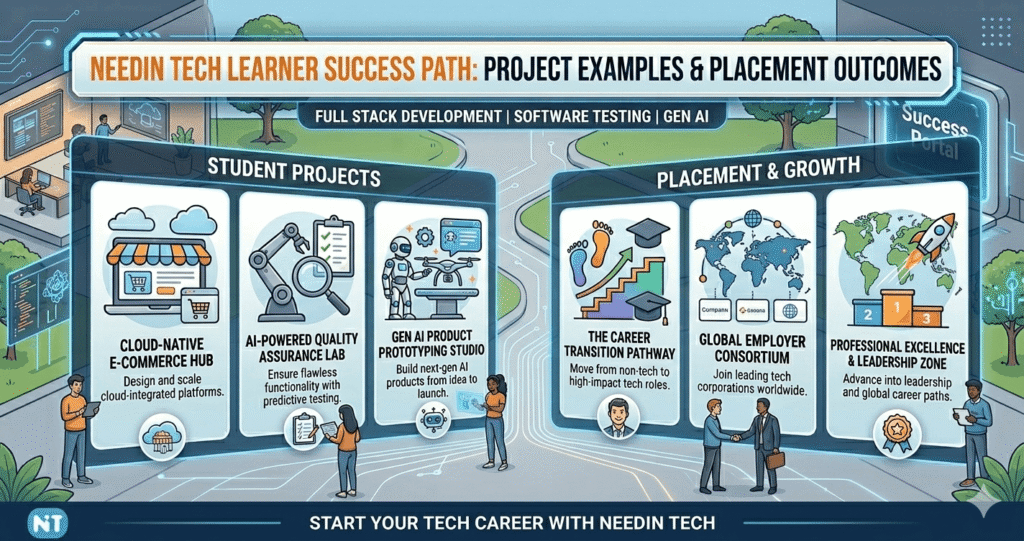
By the time you complete a NeedinTech course, you will not just have a certificate. You will have the portfolio depth and practical skills that convert training into employment. For more details, contact us today!
Frequently Asked Questions
What is a full stack developer portfolio?
A full stack developer portfolio is a list of all the projects you’ve worked on, the tools you’ve used, and the problems you’ve solved. It usually has a portfolio website, GitHub repositories for each project, and live demos that recruiters can try out. In 2026, hiring managers use it to judge developer candidates most of the time, and it often matters more than a degree or a list of certifications.
Should I build my portfolio website from scratch or use a template?
Both methods work, so it depends on how far along you are in your learning. You can use a template from GitHub Pages or Netlify to quickly get your portfolio online if you’re just starting out. This way, you can focus on the projects inside it instead of the site itself. If you know how to use React or plain JavaScript, making your own portfolio from scratch is a good idea because the site itself becomes another project for your portfolio. In either case, keep the design simple and clean. A fast-loading, user-friendly-to-navigate portfolio with strong projects behind it will always outperform a showy site with weak content.
Does a full stack developer portfolio matter more than a degree in 2026?
In most cases, yes. Hiring for tech roles is increasingly skills-first. A well-built portfolio with real, deployed projects gives hiring managers something concrete to evaluate, which a degree simply cannot. This does not mean a degree hurts you; it just means it is no longer the deciding factor it once was. What gets you the interview in 2026 is proof that you can build things. A portfolio that shows functional applications, clean code, and real problem-solving will always open more doors than just a qualification, especially for people who are new to the field or are changing careers and want to work for a startup, product company, or SaaS company.
How do you build a full stack developer portfolio with no experience?
Pick one tech stack and learn it through a structured course. Build your first project during your training. Most good full stack programs include guided project work that produces portfolio-ready applications. Deploy every project you build and push it to GitHub with a clean README, and add it to a simple portfolio website. You do not need prior professional experience to create a strong portfolio. You need real projects, live demos, and clear instructions documented. Beginners and career changers can benefit from NeedinTech’s full stack development courses. They show them how to build this kind of portfolio from the ground up.
How long does it take to build a full stack developer portfolio from scratch?
Most learners put together a solid portfolio within three to six months of starting structured training. The first month typically goes toward learning the fundamentals of your chosen stack. By month two or three, you should be building your first real project. By months four to six, you will have two or three deployed projects and a live portfolio website, putting you in a genuinely competitive position to start applying. The timeline depends on how often you practice and whether you are following a structured program or learning on your own. NeedinTech’s full stack development courses include guided project work at every level. This means that as you learn, your portfolio grows.
Published by NeedinTech, an online software training institute dedicated to helping aspirants, non-IT graduates, and career switchers build job-ready skills through expert-led courses and dedicated placement support. Check out our full stack development courses and start building a portfolio that will get you hired.