Quick Answer:
Absolutely. If you are wondering how to start a career in software testing with no experience in 2026, you are in the right place. You can begin with no experience or coding background. You can start your career journey by beginning with manual testing fundamentals, get familiar with automation testing tools like Selenium, JMeter, and Appium through structured training, build hands-on practice through real projects, and enroll in a structured course with placement support. Most beginners or college freshmen land their first QA job within 3 to 6 months of focused learning.
Introduction
Let us start this topic with the real-time observations. Here is what we observe about the software testing industry each year. Software testing has been transforming into one of the perpetually evolving landscapes in the IT industry. Freshers and professionals seeking a career change have a wonderful opportunity to build a stable and steady career in software testing. If you have been thinking about how to start a software testing career, 2026 is the smartest time to do it, with the rising demand for skilled QA professionals across IT, fintech, AI, e-commerce, and other industries.
Wondering How to Start a Career in Software Testing? Here Is Why 2026 Is the Right Time
According to the World Quality Report 2026, 78% of organizations still rely on manual testing for exploratory, usability, and ad hoc testing. Software testing is not a shrinking market. Is software testing a beneficial career in 2026? The answer is a clear yes. It is a field with consistent, ongoing demand for young aspirants and skilled professionals who know what they are doing.
Software testers are the first customers who have the opportunity to use an application firsthand. Every digital product you interact with daily, the application you use to place online orders, and the banking portal you use to transfer money through has been tried and tested by a software tester or QA team before it reaches you.
Those testers are not computer science graduates with years of coding under their belt. Software testing without a degree is entirely possible, and the QA industry has proven it repeatedly. A lot of them started out just like you are now: with no IT experience, many questions, and a real desire to build a stable, well-paying career in tech.
A career in software testing as an entry point really does require things from you. It rewards people who can think clearly, pay attention to details, solve problems in a structured way, and see things from the perspective of an end user. People from any background can learn these skills, and many already have. This is what you need to do to have a successful career in software testing.
NeedinTech has helped hundreds of freshers, non-IT graduates, and career switchers build successful software testing careers through structured, placement-focused training programs. The software testing career roadmap below shows exactly what that journey looks like, step by step, from starting from scratch to being ready for a job. Whether you are a fresher, a non-IT professional, or someone switching careers entirely, this guide is built for you. Software testing for non-IT professionals is one of the most common paths into the tech industry.
What is software testing?
Software testing is the process of verifying that a software application functions as expected. Testers identify bugs, report issues, prevent potential failures, and ensure that users have a seamless and dependable experience.
Scenario
If a login page allows users to sign in with incorrect credentials, testers need to detect and resolve the issue to ensure proper security and functionality.
Who is a software tester? A simple and clear answer
Software testers are QA (Quality Assurance) professionals who check and test software applications to make sure they work correctly and safely and meet the business needs. Every tester’s job is to find bugs, ensure the applications function correctly, conduct performance testing, and think like an end user to evaluate the application interface and resolve any issues that may arise before the application is released. Testers perform these tasks manually as well as through automated methods.
What Does a Software Tester Actually Do?
Before we dive into our practical roadmap, let us answer the question: what does a software tester do every day? Many freshers have either an oversimplified or an overly intimidating view of the role.
A software tester’s core job is to verify that a software application works the way it is supposed to and to identify ways in which it does not work before real users do. You might look over requirements on any given workday to get a sense of how a new feature should work, write test cases that cover different ways the feature could be used, run tests either manually or with automation scripts, log bugs in tools like JIRA with clear steps for reproducing them, and work closely with developers to make sure the fixes work.
Before an e-commerce app goes live, a software tester thoroughly examines the new checkout flow. This ensures that payments are processed correctly, edge cases—such as expired cards or orders with no value—are handled appropriately, and that the user experience remains consistent across all browsers and devices. The tester serves as the final line of defense for quality before thousands of real people use the product. It’s genuinely vital work.
Manual Testing vs. Automation Testing: Where Do You Start?
This is one of the first questions beginners ask: manual testing vs. automation testing, or which to learn first. It is the right question to think about early. It is the right question to think about early.
For manual testing, a person has to use the application directly. A tester interacts with the application directly, running workflows, entering data, watching how the system behaves, and noting anything that looks off. These procedures are the fundamental basics of manual software testing. Freshers should begin at this point, regardless of their educational background.
With Selenium for web automation testing, on the other hand, you write scripts that run test cases by themselves. Automation testing is usually the best choice for large-scale regression testing because it is faster and can be used again. But automation shouldn’t take the place of manual testing. The best QA specialists know when to use scripts and when to use their judgment, depending on the situation, as they assess the complexity of the test cases and the potential for human error in the testing process.
Start with manual testing. Build the thinking. Then layer automation skills on top when you are ready.
The primary reason to start with manual testing is not because automation is irrelevant. It matters enormously. Manual testing teaches you the necessary thinking, vocabulary, and structured approach that will make you a better automation tester in the future. Skipping manual testing and jumping straight into Selenium is like learning to drive on a motorway before you have ever used the clutch.
Below is a comparison table that will help you understand the difference.
| Manual Testing | Automation Testing | |
| How it works | The tester executes test cases by hand | Scripts run tests automatically |
| Best used for | Exploratory, usability, ad hoc testing | Regression, repetitive, high-volume testing |
| Coding required | No | Basic scripting (Java or Python) |
| Where to start | Beginners – start here | After manual testing foundation |
| Tools used | JIRA, TestRail, Excel | Selenium, Appium, REST Assured, JMeter |
| 2026 demand | Consistently high – 78% of organisations rely on it | Consistently high – 78% of organisations rely on it |
For anyone beginning a software testing career, manual testing is always the correct starting point. It builds the structured thinking, testing vocabulary, and defect analysis skills that make every subsequent automation tool significantly easier to learn and apply. Attempting to learn web automation with Selenium without a manual testing foundation is one of the most common and costly mistakes that fresher QA candidates make.
Now let’s begin our guide, a valuable roadmap for securing a software tester position without any prior experience.
A Step-by-Step Roadmap to Start a Software Testing Career with No Experience
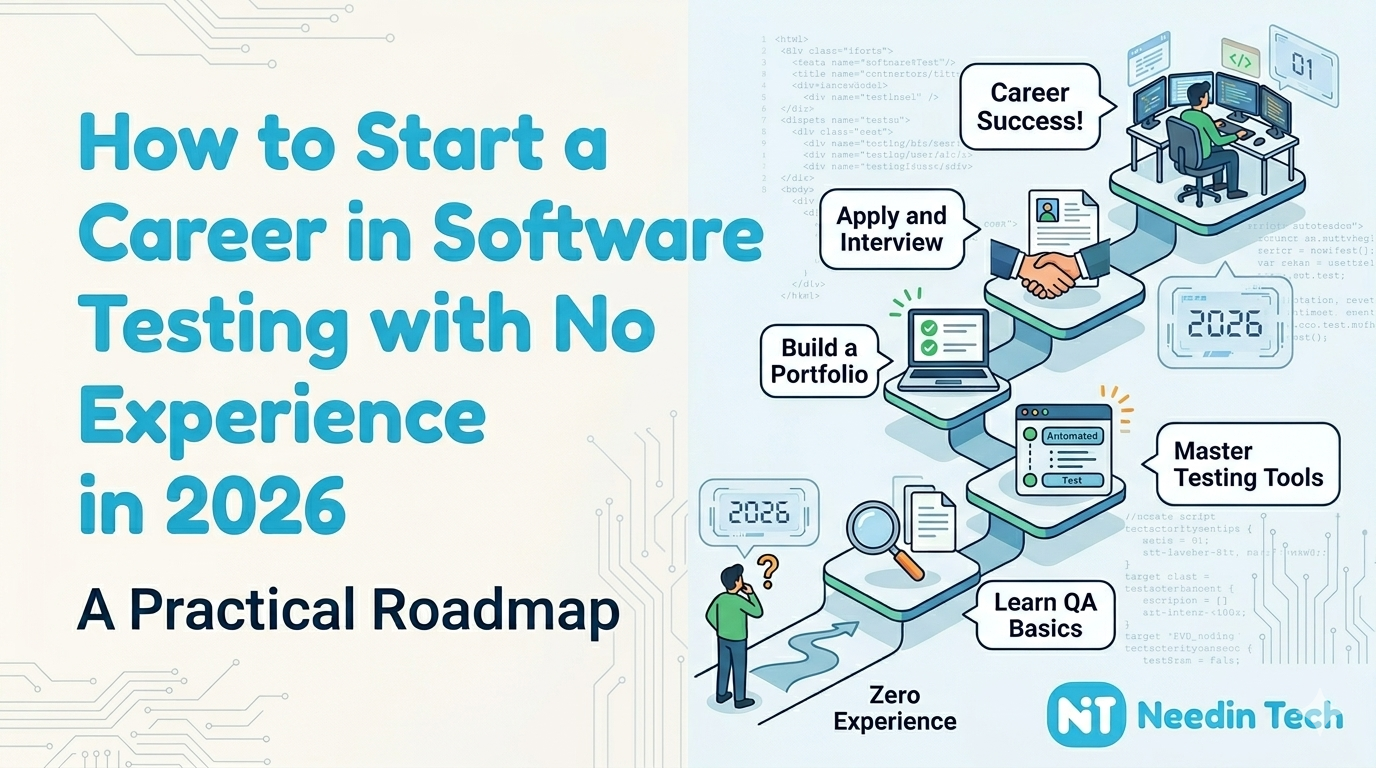
To solve the challenge of starting your software testing career with zero background, follow this step-by-step roadmap, where each step builds directly and purposefully on the one before it.
Build a strong foundation in SDLC and STLC
Having strong foundational knowledge provides the contextual framework that makes every other aspect of software testing easier to understand and apply. This is the first step on the QA engineer career path that every beginner needs to take.
The Software Development Life Cycle (SDLC) outlines the sequential stages involved in the conception, construction, testing, deployment, and maintenance of a software product. The Software Testing Life Cycle (STLC) specifically outlines the planning, design, execution, and conclusion of testing activities within the broader development process.
Understanding both frameworks before diving into hands-on testing skills gives every learner the professional context to make sense of what they are doing and why. It answers fundamental questions about why testing happens at a particular stage, what the team expects from a tester at each phase, and how a defect report feeds back into the development cycle. Dedicated study of SDLC and STLC typically takes less than a week and pays dividends throughout the entire career.
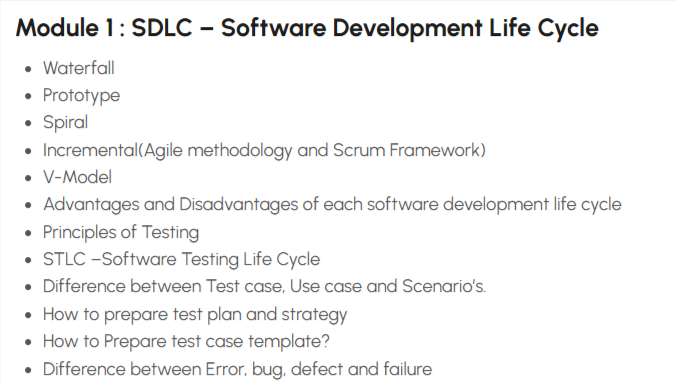
Below is a screenshot of our manual testing course Module 1 that highlights SDLC and STLC learning.
Start your career strong with manual testing
Manual testing for beginners is the non-negotiable starting point because it develops the analytical discipline every QA role depends on, whether manual or automated. It is also where you build the core software tester skills that employers consistently look for.
A solid manual testing course covers the full scope of skills a newcomer needs to begin contributing to a real project team. It walks you through writing structured test cases, tracking bugs through their full lifecycle, running tests across functional, regression, smoke, sanity, and integration types, and reporting results clearly so development teams know exactly what to fix.
Beyond the technical skills, manual testing training builds the professional habits of structured thinking, thoroughness, and clear communication that distinguish strong QA professionals from mediocre ones at every level of seniority.
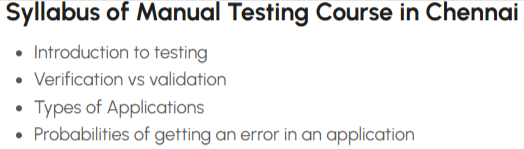
Below, you can find a screenshot of our manual testing course syllabus.
Completion of a software testing course with placement support typically requires 6 to 8 weeks of consistent, single-minded effort. The potential career return on this investment is significant.
When it comes to software testing salary for freshers in India, entry-level testers typically earn between Rs. 12,000 and Rs. 24,000 per month. Most entry-level jobs in software testing pay between 3 and 6 LPA. Professionals who add automation expertise over 2 to 4 years consistently move into the Rs. 7-12 LPA range, with API automation and performance testing specialists frequently earning above that benchmark at mid-career.
Gain Knowledge of Software Testing Tools
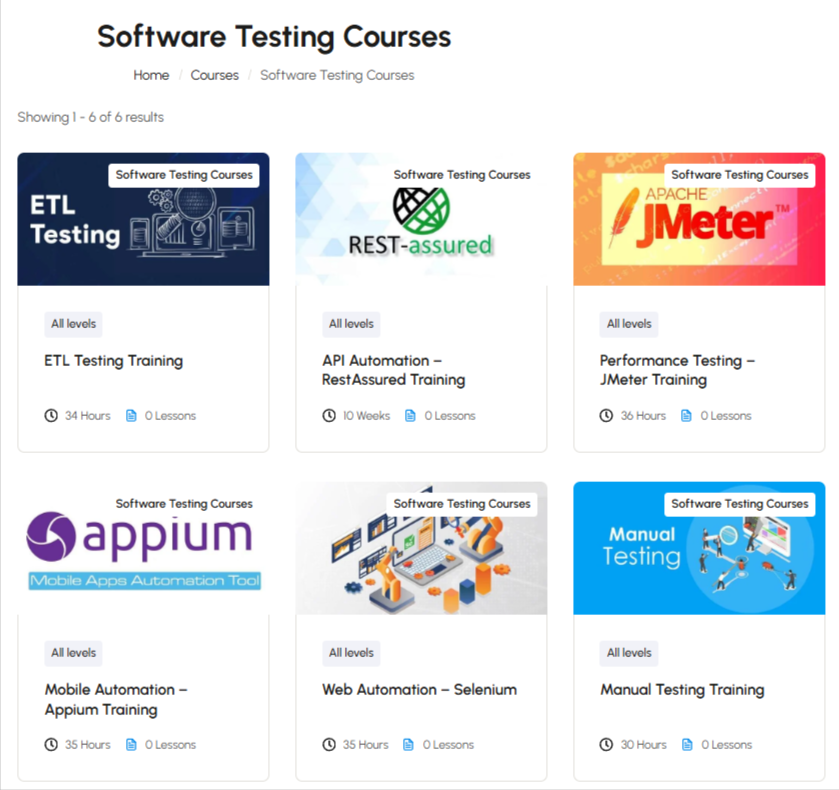
Tool proficiency is what bridges the gap between completing your training and actually getting hired. If you are wondering which testing tools a beginner should learn first in 2026, here are the best testing tools for beginners to prioritize.
- Selenium – Most companies that run web automation testing already have Selenium in their stack, which makes it the most practical tool to learn first. If you want to open the most doors in automation testing, this area is where you start.
- Appium – If manual testing is the foundation, Appium is what takes you into mobile application automation testing. It is the industry standard for automating mobile app tests. Since mobile development is not slowing down anywhere, testers with Appium skills tend to get stronger offers than those who only cover the web.
- JMeter – Every application that goes live needs to handle real user load, and JMeter is how QA teams verify that. Yes, JMeter is for performance and load testing. It simulates heavy traffic conditions so you can spot performance issues before they hit production. You will see it listed in job descriptions across all experience levels.
- REST Assured – Almost every modern application runs on APIs, and REST Assured is the standard API automation testing tool for testing them programmatically. This used to be considered a specialist skill—now it is expected in most QA roles.
- ETL Testing – This testing methodology often goes unnoticed by freshers, which is precisely why it deserves attention. ETL testing primarily focuses on validating data pipelines, ensuring accurate and integrity-driven data transfer between systems. High demand, lower competition from new candidates, and a clear learning path make it a smart area to explore early.
NeedinTech’s pro tip: Don’t give in to the urge to study more than one tool at a time. The approach that consistently produces the strongest candidates and the most confident interviewees is depth first, breadth later. First complete manual testing training, learn one automation tool thoroughly, demonstrate it through a real practice project, and then progress to the next. Employers consistently respond better to a candidate who knows one tool well than to someone with surface-level familiarity across five.
How to Build a Software Testing Portfolio with Real-World Practice Projects
The main reason freshers find it difficult to convert their training into employment is not a lack of knowledge; rather, it is the lack of demonstrated, applied experience.
Hiring managers and technical interviewers in the QA space seek evidence that a candidate has applied their skills in real project-like situations. A strong software testing portfolio is the most convincing proof you can bring to an interview. A structured training certificate is valuable, but it carries far more weight when combined with a tangible portfolio of testing work.
Building that portfolio without a paid job is entirely achievable through the following approaches:
- Pick websites and apps that anyone can access, run structured testing sessions on them, and write up your findings as proper test reports. Make sure each report includes test case IDs, test steps, expected results, actual results, pass or fail status, and severity ratings. Treat every report like something you would hand over to a real project team.
- Put together a few Selenium scripts for everyday workflows like login, search, and checkout, and push them to GitHub. That way, hiring managers can see your actual work, not just your certificate.
- Look for open-source projects that are open to community testers. Raising bug reports there counts as real experience and gives you something concrete to talk about in interviews.
- Pick apps you already use, like a banking app, a food delivery platform, or an e-commerce site, and write test cases for them as if you were working on a live project. The more seriously you treat these exercises, the more prepared you will feel when the real thing comes along.
Three or four well-structured test reports accompanied by one functional automation script consistently make a stronger impression in an interview setting than a blank portfolio supported only by course completion documentation.
How to Write a Software Tester Resume for Freshers and Build Your LinkedIn Profile
At every level of experience, resumes for software testing jobs that are specific and honest always do better than those that are long and full of fluff.
A software tester resume for freshers does not need a long list of professional experience to stand out. Instead, it must clearly and credibly demonstrate the candidate’s capabilities.
An effective resume should list the testing concepts understood, the tools used, and the accomplishments achieved with them. It should also include any training and certifications earned, as well as practice projects finished in enough detail to show that the person has real-world experience. When it comes to skills, it’s usually better to say things like “developing automated regression test scripts for login and checkout workflows using Selenium WebDriver with the TestNG framework” than things like “familiar with Selenium.”
Common mistakes that make fresher applications weaker include mentioning skills that can’t be talked about in an interview, overstating the size or difficulty of projects, and showing a generic profile that could fit any candidate instead of one that shows personal effort and preparation.
In today’s QA hiring environment, a well-maintained LinkedIn profile is just as important as a resume. QA teams seek individuals who continuously learn and require minimal guidance. They search for people who can relate to QA professionals, get involved in testing communities, and show real progress in their learning.
QA Fresher Interview Tips and How to Apply for Entry-Level Software Testing Jobs
If you’re nervous about an interview, remember that in today’s QA job market, your preparation and practical skills are more important than how long you’ve been working.
The next step is to actively seek employment now that you have a strong technical background, know how to use the tools, have a portfolio, and have a focused resume. The best entry points are entry-level software testing jobs: junior QA analyst, manual tester, and QA fresher roles. The most important principle at this stage is to begin applying before feeling completely ready. Genuine readiness for a first role develops through the interview process itself, not before it.
Here are the most practical QA fresher interview tips to prepare with:
- Practicing clear, plain-language explanations of core testing concepts without relying on memorized definitions
- Preparing to walk through a live test case writing exercise on a scenario given during the interview
- Being ready to discuss portfolio projects in specific detail covering what was tested, which tools were used, what defects were found, and how they were documented
- Researching the company’s product, understanding its primary user journeys, and thinking critically about what a tester would want to verify in those flows
According to LinkedIn’s Future of Recruiting Report, 73% of recruiting professionals already prioritize skills over degrees when evaluating candidates, and that number is expected to climb to 78% by early 2026. That shift is good news if you are starting out in software testing. Hiring managers are increasingly looking past your qualification and focusing on what you can actually do. A fresher who has put in the work, built a real portfolio, and can demonstrate their skills in an interview is genuinely competitive against any degree-holding candidate in today’s QA job market.
How Can NeedinTech Support Your Journey from Learning to Placement?
If you are figuring out how to become a software tester with no experience, the difference between understanding a roadmap and actually executing it is having structured support, expert guidance, and a learning environment built around real outcomes. NeedinTech has specifically designed its software testing course with placement support to achieve this.
NeedinTech has designed its software testing courses to follow a structured path. This program is intended for individuals who wish to begin with the fundamentals of manual testing, progress to Selenium web automation, and then explore mobile app testing with Appium. Additionally, it covers JMeter for performance testing and REST Assured for API automation or focuses on ETL testing. The program includes hands-on project experience, expert guidance, and job placement support from the very beginning.
Every course is designed to take learners from their current starting point to genuine job readiness, not just certification but the practical competence and portfolio depth that converts training into employment. In 2026, software testing jobs for freshers in 2026 are more accessible than ever. This software testing career roadmap for freshers is exactly what NeedinTech’s programs are built around.
Check out NeedinTech’s software testing courses to start your journey today. You can phone 070106 87183 or get in touch with the NeedinTech staff to find out the ideal place to start your journey based on your talents and professional goals.
Frequently Asked Questions (FAQs)
Can I get into software testing with no experience or a non-IT background?
Yes, and it is one of the few tech careers where a non-IT background is not a blocker. Software testing does not require coding knowledge to get started. What it does require is logical thinking, attention to detail, and the ability to look at an application the way a real user would. These are skills people from any academic background can develop. Many working QA professionals today started with zero IT experience. The typical learning path is 3 to 6 months of structured training, starting with manual testing fundamentals before moving into automation.
Do you need a computer science degree to become a software tester in India?
Do you need a degree for software testing? No. A computer science degree is not required to start a software testing career in India. Employers in the QA space primarily search for candidates who understand testing concepts, can think logically, and have hands-on experience with tools like Selenium, JIRA, and JMeter. You can learn all of these through a structured software testing course, regardless of your academic background. NeedinTech’s online software testing courses are open to graduates from any academic background, including arts, commerce, and science streams.
How long does it take to learn software testing and get a job?
If you are wondering how long it takes to learn software testing from scratch, the honest answer is 3 to 6 months for most beginners with consistent, structured effort. The first 6 to 8 weeks typically cover manual testing fundamentals, which is the foundation everything else builds on. From there, learners add one automation tool such as Selenium or Appium and build a small portfolio of practice projects. Those who want to go deeper into specializations like performance testing with JMeter or API automation with REST Assured can expect an additional three months on top of that.
Should I learn manual testing before automation testing?
Yes, and this is not just a recommendation. It is the sequence that produces the best QA professionals. Manual testing teaches you how to think about software quality: how to write test cases, how to trace a bug through its lifecycle, and how to assess an application from a user’s perspective. Without that foundation, automation is just running scripts without understanding what you are testing or why. Learn manual testing first, get comfortable with it, then move into Selenium or whichever automation tool fits your career goal.
Which software testing tools should a beginner learn first in 2026?
For anyone starting out in 2026, the recommended sequence is JIRA for defect tracking and bug management, Selenium for web automation testing, JMeter for performance and load testing, Appium for mobile app automation, and REST Assured for API testing. Start with JIRA and Selenium since they appear in the widest range of job descriptions. Once you are confident with those two, add the others one at a time. Trying to learn all of them at once is one of the most common mistakes freshers make. Depth in one tool consistently outperforms surface-level knowledge across five in interviews.
Is coding knowledge required for software testing?
Do you need coding for software testing? For manual testing, the answer is no. For automation testing, basic scripting in Java or Python is helpful, but you do not need it before you start. Good training programs build your scripting skills gradually as part of the automation curriculum, so you pick them up in context rather than trying to learn programming separately beforehand. If you are starting with zero coding experience, that is completely normal. Most freshers in software testing begin exactly there.
What is the starting salary for a software tester in India in 2026?
There are no straight paths in a career in software testing; it’s a journey with clear goals. As you advance, your responsibilities become more challenging, you can specialize, and your earning potential increases.
The table below shows the usual career path for software testers in India, as well as the expected compensation ranges for 2026.
| Designation | Experience Level | Typical Salary Range (India 2026) |
| QA Intern / Trainee | 0–1 years | Rs. 2.5 – 4 LPA |
| Junior QA / Manual Tester | 0–2 years | Rs. 3 – 6 LPA |
| QA Engineer / Test Engineer | 2–4 years | Rs. 5 – 10 LPA |
| Automation Test Engineer | 2–5 years | Rs. 7 – 14 LPA |
| Senior QA Engineer / SDET | 4–8 years | Rs. 12 – 22 LPA |
| Lead QA Engineer / Test Lead | 6–10 years | Rs. 18 – 30 LPA |
| QA Manager / Test Manager | 8–12 years | Rs. 20 – 32+ LPA |
| Test Architect | 10+ years | Rs. 28 – 45+ LPA |
Is software testing a viable career choice in 2026?
Yes, and the demand picture for 2026 is stronger than most people realize. According to the World Quality Report 2026, 78% of organizations still depend on manual testing, and the adoption of AI-assisted testing tools has not reduced headcount. It has shifted QA roles toward higher-value work like test strategy, risk planning, and domain expertise. Every industry that ships digital products needs testers, and that covers virtually every sector in the economy right now. For anyone looking for a stable, well-paying technology career that does not require a computer science degree to enter, software testing remains one of the most practical choices available.
What is the difference between manual testing and automation testing?
The difference between manual and automation testing comes down to how the tests are run. In manual testing, a tester interacts with the application themselves, clicking through flows, entering inputs, and logging any issues they find. Exploratory testing, usability checks, and situations requiring human judgment to evaluate the experience are the best uses for this method. Automation testing uses scripted frameworks like Selenium or Appium to run the same tests programmatically, which is faster and easier to repeat at scale. It works best for regression testing, repetitive checks, and high-volume scenarios. Most professional QA teams use both. Start with manual testing; add automation once you know what and why you’re testing.
Published by NeedinTech, a reputable training institute dedicated to helping freshers and career switchers build real, job-ready technology skills through expert-led courses and dedicated placement support. Explore the full course catalogueand take the first step toward a software testing career today.